CB8 Reverses Criticism of Private School’s Street Closure
Last year, Community Board 8 took issue with the Birch Wathen Lenox School’s seeking an Open Street permit to close East 77th Street for student use on a daily basis. Now, after the school proposed reductions in closure time, CB8 voiced its approval of the DOT application.
| 01 Aug 2025 | 01:44
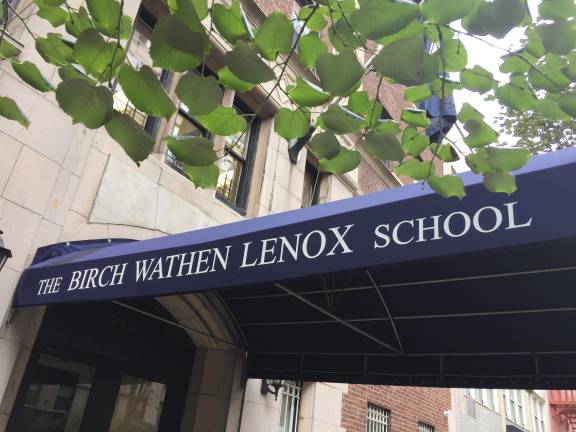
The Birch Wathen Lenox School has now earned a favorable resolution from Community Board 8 over its revised plan to close off part of East 77th Street, to use it as a recreation space for students for several days a week. (
)
Call it a reversal of a reversal. Community Board 8 recently issued a unanimous resolution voicing its advisory approval of the Birch Wathen Lenox School’s Open Streets proposal, which would allow it to close half of a block on East 77th Street to foot traffic for roughly six hours a week.
The school adamantly believes that the closure is necessary to let kids play outside, given a lack of space to do so in the K-12 college-prep school proper. The city’s Department of Transportation, which would grant the closure as part of its Open Streets programming, ultimately has the final say on whether to sign off on the proposal.
Interestingly enough, an original proposal to do so—which would have closed the street for five hours on a daily basis—earned the ire of Community Board 8’s full membership just last year, even though its transportation subcommittee approved of the project (in other words, the original reversal). A total of 36 board members voted in favor of a “motion of disapproval,” with one board member even calling the plan “outrageous.”
At a meeting of the board’s transportation subcommittee on July 2, a representative for the school began his presentation on the revised proposal with an apology. “I just want to acknowledge up front that our initial approach wasn’t what it should have been,” Bill Kuhn said. “We apologize and we’ve taken that to heart. We’re here to engage in a good-faith way, for the betterment of all of us and for our community.”
At one point, Kuhn also said that “we didn’t do enough outreach” around the school’s first proposal, and that “we’re doing the work” to change that now. He pointed out that the school had talked to 10 businesses on the block.
He then described the Open Streets proposal as “an educational and developmental priority. . . . We’re not asking for special treatment, we’re asking for the same opportunities as others.” He added that leaving parked cars on the street would be fine, that deliveries would be permitted, and that trained staff would usher kids off the street if an ambulance needed passage to nearby Lenox Hill Hospital.
Following his presentation, a tit-for-tat between local residents began. Some were persuaded by the revised plan, while others remained steadfast in their opposition.
Todd Layne, who said he owned an “eco-friendly laundromat” on the block, called the proposed street closure “incomprehensible.” Linda Cornelius, who runs a block association on the street, echoed Layne; she said she “wasn’t sure” what’s substantially changed since the school’s last proposal, and that the “community is highly opposed” to the closure coming to a “high-density” block.
Other community members, however, didn’t seem much opposed at all. Kirby Kersels, who said that he lived next to the school, argued that the school had “substantially addressed” the community’s questions. “It’s really, really important that students are allowed time outside,” he added.
Maggie Leahman called Birch Wathen Lenox an ”integral and historical part of the community and the street.” She then lit into some of the other meeting participants: “I’d like to request that any further public comments lower the snark level. I take offense that the school has been accused of lying. I really think that serves no purpose.”
Either way, by July 16, the full board passed a resolution favoring the revised proposal by a vote of 42 to nil.
“I just want to acknowledge up front that our initial approach wasn’t what it should have been.” — Birch Wathen Lenox School rep Bill Kuhn