return to my peace corps home

In 1973, when I was 22 and fresh out of college, I was unsure of my next act and decided to join the Peace Corps. I had met a Peace Corps recruiter on campus, and while all of us college graduates were figuring out how to live out our idealism and evolving world-view in the Vietnam War era, I decided to leave friends and family behind. Ten days after graduation, I was on a plane to Bogotá, Colombia to work in a youth and recreation program. My suburban Long Island parents had little context for this decision. On the way to the airport, my father turned to my mother and said, “Let’s pretend he’s going into the army for two years.”
I didn’t believe that I was going off to change the world. I had a cursory interest in Latin America, a foundation of high school Spanish, but a deep curiosity about immersing myself in another culture. Like most 22-year-olds, I was somewhat brash, with a jaundiced view of the United States role in the world. In my mind, the JFK idealism of the Peace Corps had evolved into a Nixonian form of imperialism, in which the United States was to blame for fomenting the economic disparity in countries like Colombia. When I left the Peace Corps in 1975, I wrote a scathing letter to my supervisor advocating that the Peace Corps pull out of Colombia since it played no viable role in Colombia’s development.
What I failed to recognize at the time was that the experience was life-changing. I returned to the States fluent in a second language and with a deep appreciation of South American history and culture. The decades I later spent as a community worker at Goddard Riverside Community Center took shape in the rural hills of Colombia, where I used my athletic skills to teach physical education and become an accepted co-worker in a local school. While I recognized the inherent contradictions of my presence in the country, I ended up being the perfect ambassador — exactly what the Peace Corps wanted.
On my post-retirement bucket list has been my desire to return to my Peace Corps home in the town of Vélez, in the beautiful central range of the Colombian Andes five hours outside of Bogotá. For the past four decades, I have carried wonderful memories of the “colegio cooperativo” (cooperative high school) where I taught and the people who took me in as their resident “gringo,” along with the Colombian music, food and more simple way of life. I had that incredible opportunity last month.
The return to Colombia after a 43 hiatus was spurred by a wedding in Bogotá that my daughter was attending. Her close high school friend, who has family in Colombia, was getting married at a beautiful venue an hour outside of the capital. We decided to make it a family trip and I would finally have the chance to return to the place that had such an influence on me.
I approached the trip with some trepidation, not knowing how I would be received or if anyone I knew was still in Vélez. The month before we left, my wife went online to research Vélez, and sure enough, the town had its own website, “Visite Vélez.” I contacted the name mentioned on the site and sent a long email with the names I plucked from old letters I had written home and saved to this day — the local priest, the family who owned the farmhouse and my co-worker Serafin Rodriguez, the physical education teacher in the elementary school who became my closest friend. The week before we left for Colombia, I received a call (WhatsApp is a wonderful thing) from Serafin, who couldn’t believe that I was really planning to visit.
The return to Vélez capped a remarkable ten days in Colombia. Seeing Serafin again brought a wave of emotion. He and his wife, Luz Marina (a student during my time there), opened their home and hearts to us. There were tears of joy when we went to the home of Don Juan Quiroga Reyes, now well into his 80s, who had headed the school and was the one who had requested a Peace Corps volunteer. His daughter Lulú reminisced about how we won the departmental female basketball championship and claims Vélez never won another after I left.
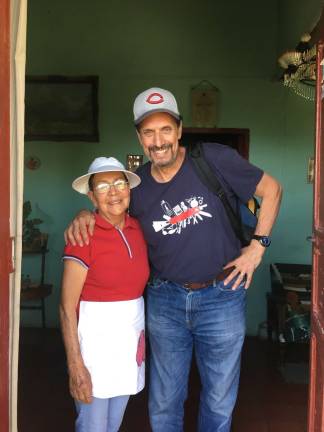
We visited Cecilia Meneses who still lived in the same house at the bottom of the hill. Daily she would come up to the house, milk the cow and leave me with a fresh liter of milk for my morning breakfast. “Hola Don Esteban!’’ she shouted when she saw me.
Colombia certainly has changed in the four ensuing decades. As Serafin pointed out, the “campesinos” (peasant farmers) now ride motorcycles instead of horses and donkeys, and the world is much smaller with ubiquitous Wi-Fi. Still, much was how I remembered Vélez — the side-entrance church, slanted plaza, and roadside picnic places. The “pechuga a la parilla” (grilled chicken breast), “arroz de coco” (coconut rice), “arepa con queso” (cheese corn bread) and fresh fruit juices were as delicious as ever.
“Colombia mi querida” (my dear Colombia)! How lucky to have had the good fortune to rekindle old friendships.